Float and Cash Flow Frog both turn accounting data into a rolling cash flow forecast, and they suit different buyers. Float is built for finance teams in medium to large businesses running Xero or QuickBooks Online who want consolidated, multi-entity visibility. Cash Flow Frog suits small business owners who want a wide range of integrations, including QuickBooks Desktop and direct bank feeds.
What each tool is and who it is for
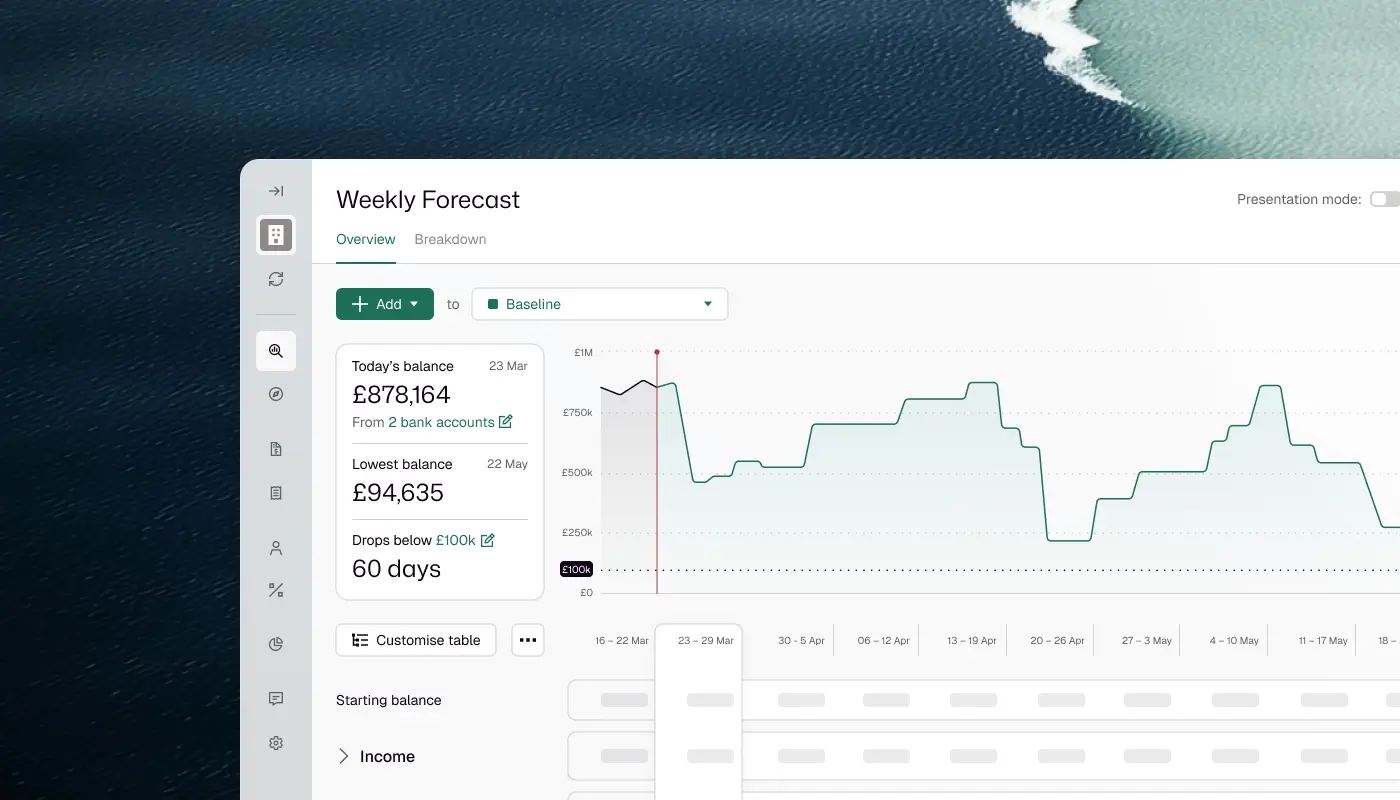
Float is cash flow forecasting software for finance teams in medium to large businesses, typically a finance function of three to six people inside a company of 11 to 50 staff. It connects to your accountancy software or ERP, with Xero and QuickBooks Online live today, and reads reconciled accounting data on a daily and on-demand sync, and produces a 13-week rolling forecast and a monthly view reaching up to three years out. From day-to-day cash management to strategic cash planning, it gives the finance team one place to stay on top of every cash movement, with comments and tagging on budget lines so decisions stay in the forecast rather than an email chain. Every plan is published in pounds and dollars, with scenario planning included and no per-user charges. A direct Sage Intacct connection is being built, with a waitlist open now.
Cash Flow Frog is cash flow forecasting software built for small business owners, with a wide integration surface: QuickBooks Online, QuickBooks Desktop, Xero, Sage Intacct, Zoho Books, FreshBooks and Odoo, plus direct bank feeds through Plaid for businesses without accounting software. It produces a rolling 36-month forecast with daily, weekly, monthly and quarterly views, and it prices its standard plan by annual revenue band in US dollars. Its Sage Intacct plan is priced separately, by entity count and by which Intacct dimensions you use.
Float and Cash Flow Frog side by side
Both columns state each product's published position as of late August 2026. Pricing and plan details change; check each vendor's pricing page before deciding.
| Float | Cash Flow Frog | |
|---|---|---|
| Accounting platforms | Accountancy software or ERP: Xero and QuickBooks Online live; Sage Intacct waitlist | QuickBooks Online, QuickBooks Desktop, Xero, Sage Intacct, Zoho Books, FreshBooks and Odoo |
| Bank data | Read through the accounting platform; no direct bank feeds | Direct bank feeds through Plaid, alongside the accounting integrations |
| Forecast horizon | 13-week rolling view, plus a monthly view to 12 months on the entry plan and 36 months on higher plans | Rolling 36 months on every plan |
| Views | Daily, weekly and monthly, including the 13-week rolling view | Daily, weekly, monthly and quarterly, including a 13-week view |
| Forecast structure | Mirrors your chart of accounts, with grouping and single-account deep dives | Mirrors the platform's categories: Intacct dimensions, Xero tracking categories, QuickBooks classes |
| Drill-through | Account-level detail | Breakdown table three levels deep, with drill to source invoices and bills |
| Scenarios | Scenario planning on every plan, with scenarios compared side by side | What-if scenarios duplicated from a base forecast, compared side by side |
| Cash flow statement view | Not offered; Float forecasts cash in and cash out rather than a three-statement model | Statement mode grouped by operating, investing and financing activity |
| VAT and GST | Automatic VAT and GST forecasting for Xero users in the UK, Australia and New Zealand | VAT and GST returns forecast for QuickBooks Online companies in the UK and Australia, and Xero companies in the UK, Australia and New Zealand |
| Automation | Auto budgets that track your three or six-month averages, linked budgets set as a percentage of another line, and suggestions drawn from your history | Projection suggestions after every sync, and four rule types for recurring lines |
| AI assistant access | Not offered | MCP connector for Claude, ChatGPT, Copilot and Gemini |
| Multiple entities | Consolidation with currency conversion on the Scale plan; up to five entities, then priced per entity | Multi-entity consolidation with multi-currency conversion, included on its standard plan; the Sage Intacct plan is priced by entity count |
| Team collaboration | Unlimited users; comment on budget lines and tag teammates, with Admin, Editor and Viewer roles | Up to 10 users |
| Trial | 14 days, no card required | 14 days, no card required, with a 30-day money-back guarantee |
| Pricing | Three published plans in GBP and USD, from £79 or $105 a month billed annually | Priced by annual revenue band in USD; the entry band lists at $55 a month |
Why small business owners choose Cash Flow Frog
Cash Flow Frog connects to multiple platforms. If your business runs Sage Intacct, Zoho Books, FreshBooks or Odoo, it has a live integration and Float does not. Its Plaid connection also covers businesses with no accounting software at all, forecasting straight from bank transactions, which Float does not do by design: Float reads reconciled accounting data so that the forecast matches the books.
It also carries QuickBooks Desktop, which deserves context rather than a tick alone. QuickBooks Desktop was discontinued in the UK in June 2023 and has not been accepted for Making Tax Digital VAT submissions since April 2024. In the US, new subscriptions for the main Desktop products ended in September 2024, leaving an installed base that can renew and an Enterprise product that remains on sale. A Desktop integration is a real advantage for that US installed base, and close to no advantage in the UK.
Beyond integrations, Cash Flow Frog offers a cash flow statement view grouped by operating, investing and financing activity, breakdowns that follow whichever categories your platform holds, and an MCP connector that lets you work with the forecast through Claude, ChatGPT, Copilot or Gemini. Float offers none of these today. The trade-off is scale: the 10-user cap that fits an owner-led business is also a common reason larger finance teams outgrow Cash Flow Frog.
Where Float wins
Float is built for the finance team rather than the owner-operator. Every plan includes unlimited users, so the finance manager, the FD and every budget owner can work in the same forecast without a per-seat decision, and the conversation happens where the numbers are: comment on any budget line and tag the teammate whose input you need, so nothing gets lost in an email chain. Cash Flow Frog caps accounts at 10 users on its published plans, which fits a small business and constrains a finance function that wants the wider company contributing.
Consolidation is part of the product. The Scale plan includes multi-entity consolidation with currency conversion for up to five entities at a published price in GBP or USD, with the group position visible immediately and drill-down into any entity, and nothing about your reporting categories moves you between pricing tiers.
Most of all, Float is built so a finance team can trust the cash process: it reads only reconciled accounting data, so the forecast agrees with the books at every sync. That matters most when the forecast is shared upwards to a board or a lender. Automatic VAT and GST forecasting for Xero users in the UK, Australia and New Zealand keeps the largest recurring liabilities in the forecast without manual entry, and the 13-week rolling view gives a finance team a standing weekly operating rhythm instead of a report rebuilt each month.
Class, location, department and project are Intacct's structure
Forecast breakdowns by class, location, department and project look like a feature of the forecasting tool. They are a feature of the ledger. Class, Location, Department and Project are standard dimensions in Sage Intacct's data model, and a forecasting tool that syncs Intacct inherits them. The same tool connected to Xero offers whatever tracking categories you have set up, and connected to QuickBooks Online it offers classes. No forecasting tool gives you dimensions your ledger does not hold.
This matters in both directions. If you are on Sage Intacct with dimensions in active use, a tool that reads them will structure the forecast the way your reporting already works, and that is a genuine reason Cash Flow Frog suits Intacct customers today. Note that its Sage Intacct plan is priced partly by those dimensions: using Location moves you up a pricing tier, and using Departments, Classes or Projects moves you higher again. If you are on Xero or QuickBooks Online, the dimension list does not apply to you, and a comparison built around it is answering someone else's question.
It is also worth knowing what Sage Intacct itself provides. Core Intacct gives you a dimensioned general ledger, strong multi-entity consolidation and cash management for recording and reconciling positions. Forward planning sits in Sage Intacct Planning, a separately licensed budgeting and FP&A product. An Intacct customer who wants a rolling, operational cash flow forecast is therefore choosing between third-party tools either way.
Mid-market integrations are coming to Float
Float connects to your accountancy software or ERP. Xero and QuickBooks Online are live today, and a direct Sage Intacct connection is being built. If you run Sage Intacct, you can join the waitlist now and be first in line when the integration ships: join the Float for Sage Intacct waitlist.
What each tool costs
Float publishes three plans in both GBP and USD, billed monthly or annually. As of late August 2026: Essentials at £79 or $105 a month billed annually (£99 or $130 monthly), Growth at £159 or $215 (£199 or $265 monthly), and Scale at £235 or $315 (£295 or $389 monthly), with Scale covering up to five entities and then a per-entity price beyond that. Every plan includes unlimited users and a 14-day free trial. Current details and scenario allowances are on the Float pricing page, and the wider market context is in our guide to what cash flow forecasting software costs.
Cash Flow Frog prices its standard plan by annual revenue band, in USD only. As of late August 2026 the entry band, covering businesses up to $1M in revenue, lists at $55 a month, and annual billing runs 20% below monthly. The Sage Intacct plan is priced by entity count and dimension usage, from $199 a month for up to three entities, and the accountants plan is priced by the number of client companies. Cash Flow Frog caps accounts at 10 users on its published plans.
Frequently asked questions
Does Float integrate with Sage Intacct?
The waitlist is now open and you can join it on the Float for Sage Intacct page. Float connects to your accountancy software or ERP, with Xero and QuickBooks Online live today, and the direct Sage Intacct connection is being built now.
Does Cash Flow Frog integrate with Sage Intacct?
Yes. Cash Flow Frog has a live Sage Intacct integration with a one-way sync, breakdowns by Intacct dimensions such as entity, location, class, project and department, and multi-entity consolidation. Its Sage Intacct plan is priced by entity count and by which dimensions you use, from $199 a month.
Can I forecast cash flow by class, location, department or project?
Only if your accounting platform holds those structures. They are Sage Intacct dimensions, so a Sage Intacct business with a tool that reads them can forecast that way. On Xero the equivalent is tracking categories, and on QuickBooks Online it is classes. Float structures the forecast on your chart of accounts across every platform it connects to.
Which tool handles multiple entities and currencies?
Both offer multi-entity consolidation with currency conversion. Float includes it on the Scale plan, covering up to five entities with a per-entity price beyond that and converting every entity into your chosen reporting currency. Cash Flow Frog includes consolidation on its standard plan across the platforms it supports, and prices its Sage Intacct plan by entity count.
Does Float have direct bank feeds?
No, and this is a design decision rather than a gap in the roadmap. Float reads reconciled data through Xero or QuickBooks Online so the forecast always matches the books. Cash Flow Frog offers direct bank feeds through Plaid, which suits businesses that want to forecast without accounting software in the loop.
Does either tool work with QuickBooks Desktop?
Cash Flow Frog integrates with QuickBooks Desktop; Float does not. Worth weighing: QuickBooks Desktop was discontinued in the UK in June 2023 and has not been usable for Making Tax Digital VAT submissions since April 2024, and US sales to new subscribers of the main Desktop products ended in September 2024. For most UK finance teams the Desktop question is settled by the platform, not the forecasting tool.
What security controls does Float offer?
Float uses a one-way, read-only connection to your accounting platform, so nothing writes back to the ledger. Access is controlled with Admin, Editor and Viewer roles, two-factor authentication is mandatory for Xero users, and Float holds Cyber Essentials certification.
How much does each tool cost?
As of late August 2026, Float's plans run from £79 or $105 a month billed annually to £235 or $315, published in full on the Float pricing page. Cash Flow Frog's standard plan is priced by revenue band in USD, listing at $55 a month at the entry band, with its Sage Intacct plan from $199 a month by entity count.
Float and Cash Flow Frog answer the same question for different businesses. If yours is a scaling finance team on Xero or QuickBooks Online that wants one place for every cash conversation and decision, start a 14-day Float trial. If you are on Sage Intacct, join the Float for Sage Intacct waitlist and compare the dedicated Intacct tools in the meantime. Our comparison of Float and Agicap covers the treasury end of the market.