The cash forecast your whole business finally agrees on
The trade every finance leader knows
Keep the forecast broad and simple, and miss the nuance that matters. Or spend hours building a proper 13-week model, and watch it go stale before you've finished it.
We've spent fifteen years working on this problem. Float is a live, transaction-level cash flow forecast that's accurate enough to make decisions on, without the complexity of a full FP&A system.
We hold one belief above everything: you can't trust a number you can't trace.
Every figure in Float links back to the transaction or budget it came from. As AI makes forecasts cheaper to generate and easier to make look credible, traceability is what separates a forecast from a guess.
What Float is
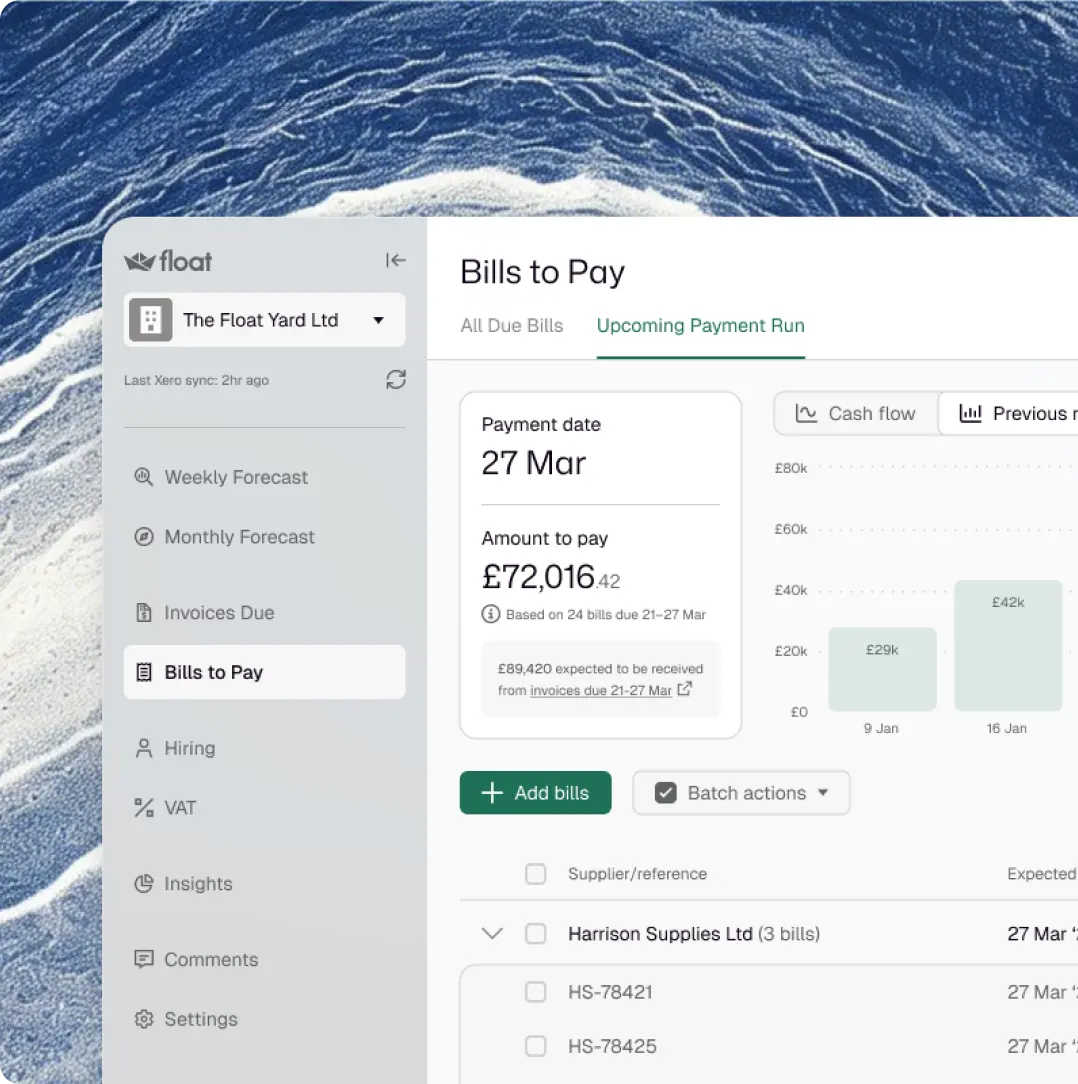
Float connects directly to Xero and QuickBooks Online and builds a rolling cash flow forecast from your live accounting data. Not last month's numbers. Not a model someone will update when they get a moment. What's actually in the bank, what's actually coming in, and what's actually going out. Float is not your accounting tool. It's what sits on top of it and tells you what's actually coming.
Think of it like this: Float is the missing cash decision layer between your accounting software and your reporting or FP&A tools.
It’s not built to handle invoicing, accounting, or general ledger management. But for the finance team that needs to know what the cash position will be on the 14th, before the board meeting on the 13th, it's the only tool built specifically for that job.
Float is used by CFOs, Finance Directors, and their team, at businesses that are past the point where a spreadsheet is good enough, but not yet at the scale where a full FP&A platform makes sense. Over 8,000 finance teams use Float. Built and run by a team of twelve, based in Edinburgh.


The question that started this
I built Float because I couldn't answer a simple question: could I make payroll next month?
Client payments were unpredictable. I had no clear view of what was coming. That felt like a solvable problem, so I started solving it. Fifteen years later, I still get messages from finance leaders who are sitting with exactly that feeling, not during a crisis, but on an ordinary Tuesday.
The value of Float isn't always in the daily check. It's in knowing the numbers are current and waiting for the moment something shifts.
What fifteen years taught us
The budget is rarely what drives short-term cash flow. It's the project approved outside the budget last month, or the cancelled project nobody has pulled from the system yet. If you're only looking at planned numbers, you're not seeing what's actually moving.
Forecasts rarely fail for one reason. It's usually several timing factors arriving at once, a delayed invoice, a budget revision that wasn't updated, an approval that came through late. The compounding effect is what creates the unexpected gap. Seeing it before it arrives means having a model that's live, not one that gets recalculated at month end.
We built Float for accountants first. It took us longer than it should have to realise that the people doing the day-to-day forecasting work aren't accountants. It's the finance team, the people close enough to the business to know when a deal slips or a payment stalls. The product changed significantly once we understood who was actually doing the work.

The Team
When you contact Float, you reach people who have been working on cash flow problems for years. Ashleigh, Graeme, Jane, and Matt lead our customer success work.
Between them, they've helped finance teams through payroll crunches, delayed funding rounds, and the kind of cash timing problems that only show up at the worst moment. If you're stuck, they've probably seen it before.