For a finance team of three or more running Xero, QuickBooks Online or Sage Intacct, the shortlist splits by what the tool is built to do. Dedicated cash flow forecasting tools (Float, Cash Flow Frog, Dryrun) cover day-to-day cash management and the weekly cash decision. Three-way forecasting and reporting suites (Fathom, Futrli, Spotlight Reporting, Syft Analytics) cover longer-range planning and board reporting. Treasury and cash management platforms (Agicap) cover multi-bank group treasury. The right pick depends on the job in front of you, and on which ledger you run.
| Tool | Category | Ledgers (Xero / QuickBooks Online / Sage Intacct) | Best fit |
|---|---|---|---|
| Float | Dedicated cash flow forecasting | Xero and QuickBooks Online live; Sage Intacct coming soon | Scaling finance teams on Xero or QuickBooks Online that want one place for day-to-day cash management and strategic cash planning |
| Cash Flow Frog | Dedicated cash flow forecasting | All three live | A finance team that wants a rolling forecast with daily detail and consolidation, fast |
| Dryrun | Dedicated cash flow forecasting | All three live | A controller who wants manual control over every assumption across several entities |
| Fathom | Three-way forecasting and reporting | Xero and QuickBooks Online; Sage Intacct not listed | Board reporting and multi-entity consolidation with monthly forecasting |
| Futrli | Three-way forecasting and reporting | Xero and QuickBooks Online; Sage Intacct not listed | Daily cash forecasting inside a reporting suite, every feature on every plan |
| Spotlight Reporting | Three-way forecasting and reporting | Xero and QuickBooks Online; Sage Intacct in beta | Five-year three-way forecasts and consolidation across many entities |
| Syft Analytics | Three-way forecasting and reporting | All three live | Long-horizon planning and consolidation, with analytics and reporting attached |
| Agicap | Treasury and cash management | All three live | A group with many bank accounts and entities across several countries |
How this list is organised
The market sorts into four groups, and the group matters more than any single feature. Built-in planners come with the accounting platform. Dedicated cash flow forecasting tools sit on top of the ledger and forecast cash only. Three-way suites forecast the profit and loss and balance sheet as well as cash, usually with reporting attached, and shade into full FP&A at the top end. Treasury and cash management platforms connect to banks directly and run treasury processes for multi-entity groups. The alternatives to spreadsheets guide sets out the same four categories from the spreadsheet side.
Inside those groups, one distinction decides most shortlists for a finance team of this size: the granularity of the forecast. A tool that forecasts in months answers a planning question. A tool that forecasts in days and weeks answers the operational question a finance manager has on a Friday, which is what to pay, what to chase and whether the balance holds through the next payroll. Several well-regarded tools do the first and not the second, and their own documentation says so.
Built-in planners
Xero includes Cash Flow Manager and QuickBooks Online includes the Cash Flow Planner. Both are adequate for a single-entity, single-currency business that wants a projection without a second system. Both stop short at scenario planning, multi-entity views and adjustable payment timing across every invoice and bill, which is where the dedicated category starts. The built-in versus dedicated comparison covers the boundary in detail, with separate guides for Xero and QuickBooks Online.
Dedicated cash flow forecasting tools
These tools import invoices, bills and bank data from the ledger and forecast cash forward at daily or weekly resolution. They sit in the layer between the accounting platform and FP&A: the ledger holds the source of truth, FP&A models the future, and these tools manage the cash decisions in between. They are the category for a finance team whose job is day-to-day cash management and the weekly cash call.
Float
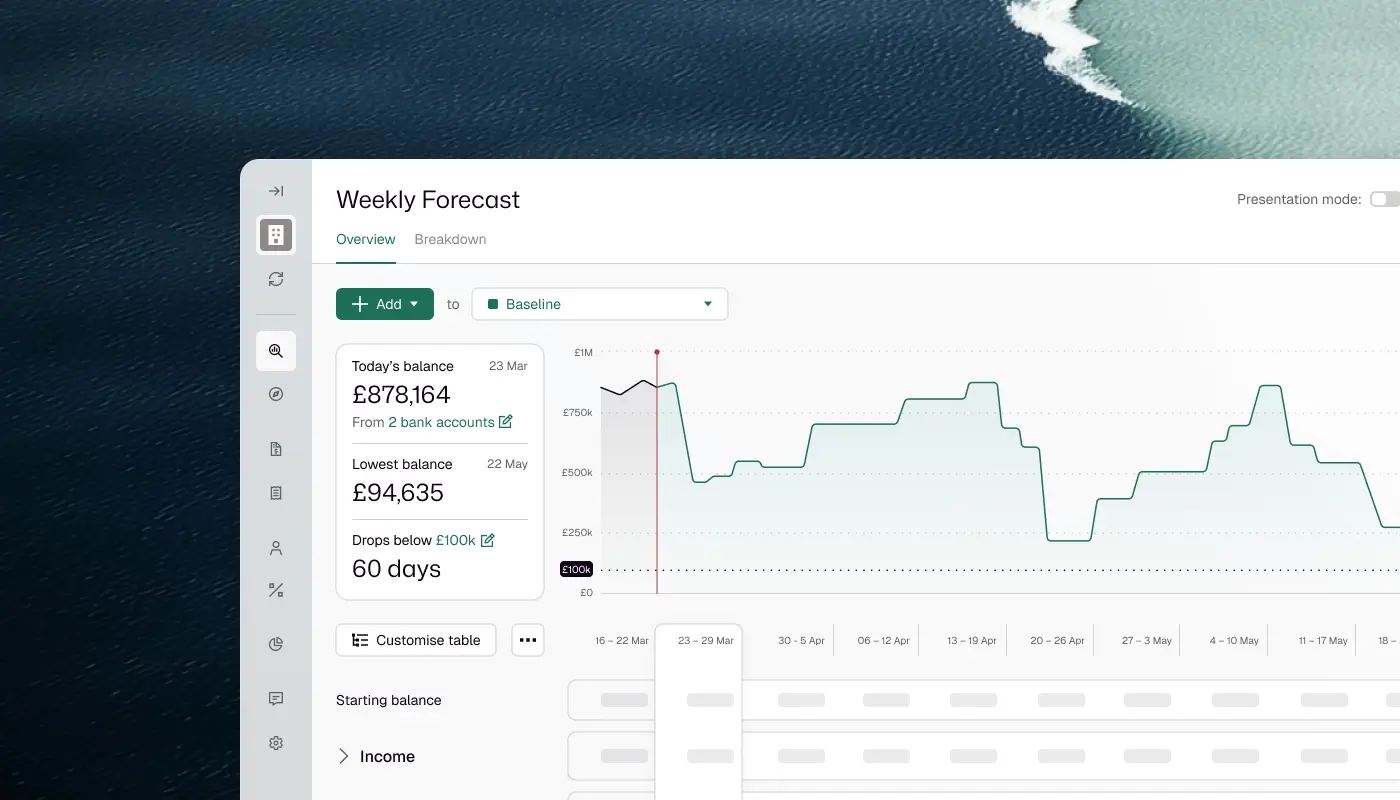
Float is the cash decision layer between the accounting platform and FP&A: the ledger holds the source of truth, FP&A models the future, and Float manages the cash decisions in between. Connected to Xero or QuickBooks Online through a one-way, read-only connection, it turns live transaction data into a rolling cash flow forecast the finance team can trust, and gives the team one place for every cash conversation and decision, from day-to-day cash management to strategic cash planning. Reconciled bank balances, invoices and bills import once a day at a chosen hour, with a manual refresh available. The 13-week rolling weekly view is built for day-to-day decisions; the monthly view is built for board conversations and planning, and runs to 12 months on the entry plan and up to three years above it. Sage Intacct is listed as coming soon, with a waitlist. Float forecasts cash, not the profit and loss or balance sheet, which is the trade a finance team makes for a forecast that stays close to what the bank will actually show.
The working forecast is built from budgets that act as placeholders until the invoice, bill or bank transaction arrives, at which point the actual replaces the estimate. Expected payment dates are set per invoice and bill, and suggestions drawn from the transaction history flag recurring costs so the forecast stays accurate with less maintenance. Scenarios are layers stacked on the base forecast and toggled on and off, with a set allowance of scenario layers on every plan, detailed on the pricing page. Multi-entity consolidation is a Scale-plan feature, with up to five entities included and currency conversion into a display currency, built as a group cash view rather than a statutory consolidation. The team works in one forecast: comments sit on any budget line, invoice or bill, admin, editor and view-only roles control access, two-factor authentication covers accounts, and every plan includes unlimited users. Plans start at £79 a month on annual billing as at August 2026, with the full list and dates in the cost guide.
Best fit: scaling finance teams on Xero or QuickBooks Online that want the weekly cash call and the longer-range cash plan to come out of one forecast the whole team can stand behind. Wrong choice: a Sage Intacct business today, or a team that needs three-way forecasting, intercompany eliminations or a direct bank feed. Group consolidation is covered in the multi-entity guide.
Cash Flow Frog
Cash Flow Frog connects to QuickBooks Online, QuickBooks Desktop, Xero and Sage Intacct, plus Zoho Books, FreshBooks, Odoo and bank feeds through Plaid, and builds a rolling 36-month forecast with daily, weekly, monthly and quarterly views and a 13-week view. Scenarios are named, duplicated from the base forecast and compared side by side. Consolidation covers unlimited entities in multiple currencies, with the forecast broken down by entity, location, department, class, project, customer or supplier. The Sage Intacct connection is one-way and never writes back.
Pricing works two ways. For Xero and QuickBooks connections the price is set from the business's annual revenue, read from the ledger at connection, so the figure a business of £2.5M to £10M pays is not the entry-tier price shown on the site. For Sage Intacct there is a separate published per-entity price list. A free trial runs without a card.
Best fit: a finance team that wants a forward cash view with daily detail and consolidation, on any of the three ledgers, without an implementation project. Wrong choice: a team whose primary need is a three-way model or a management reporting pack. For a direct head-to-head, see Float versus Cash Flow Frog.
Dryrun
Dryrun connects natively to Xero, QuickBooks Online, Sage Intacct (its Intacct integration went live in August 2026) and Microsoft Dynamics 365 Business Central. It forecasts on three timelines at once: daily transaction-level, a rolling 13-week operational view and monthly strategic projections. Its distinguishing position is manual control. Every automated assumption can be overridden by hand, and the vendor markets that as the alternative to forecasting tools that guess from history. Scenarios are duplicated in one click and compared on a single graph, and multi-entity, multi-currency roll-ups are a headline feature.
Dryrun does not publish pricing. Every route on its site leads to a demo booking, and its standard term is one year. The site now speaks to the office of the CFO at mid-market scale.
Best fit: the upper end of a finance-led team, with several entities, real receivables timing risk and a controller who wants to own every assumption. Wrong choice: a team that wants to trial a tool this month and see the price before talking to sales.
Three-way forecasting and reporting suites
These tools forecast the profit and loss, balance sheet and cash flow together and pair the forecast with management reporting and consolidation. Most began life serving accounting practices, and their idiom still leans that way. They suit a finance team whose job is the board pack and the annual plan more than the weekly cash decision.
Fathom
Fathom, now part of The Access Group, connects to Xero, QuickBooks Online and QuickBooks Desktop, MYOB and Sage, with Sage Intacct not listed among its integrations. It produces three-way forecasts by the indirect method for three financial years beyond the current one by default, extendable to five, with scenarios built from one main forecast by changing timing and value rules. Multi-currency consolidation is included on every plan, with no limit on the number of consolidated groups and translation across more than 95 currencies. Pricing is published and set by the number of connected company files, with unlimited users.
The boundary is stated in Fathom's own product FAQ: forecasts are monthly, quarterly or annual, not daily or weekly.
Best fit: a finance team whose priority is management reporting, longer-range planning and consolidation across several entities on Xero or QuickBooks Online. Wrong choice: the weekly liquidity decision, and any business on Sage Intacct.
Futrli
Futrli, owned by Sage since 2022 and still sold to Xero and QuickBooks Online users, connects to Xero, QuickBooks Online and Sage Accounting. Sage Intacct is not among its integrations, and ownership should not be read as a connector. Its differentiator inside the suite category is daily cash flow forecasting with confidence scoring on predicted transactions, alongside a three-year three-way forecast, budgets, scenario modelling and multi-currency consolidation. Every feature is on every plan; plans differ only by the number of licences. A single business licence is £40 a month as at August 2026.
Best fit: a team on Xero or QuickBooks Online that wants daily cash forecasting inside a reporting suite at a low entry price. Wrong choice: a Sage Intacct business, and a team that finds the practice-first plan structure, built around clients and licences, a poor match for an in-house function.
Spotlight Reporting
Spotlight Reporting connects to Xero and QuickBooks Online, with a Sage Intacct integration currently in beta. Forecasting runs to 60 months across profit and loss, balance sheet and cash flow, with scenarios created by copying a forecast and flexing it. Consolidation covers up to 50 entities with intercompany eliminations on the business plans, and a separate product handles larger franchise and not-for-profit groups. UK business pricing is published: £35 a month for a single organisation as at August 2026, with a 20-organisation plan above it.
Spotlight's reports use monthly values only, which its own help centre states, so it forecasts the plan rather than the week.
Best fit: a team that needs a three-to-five-year three-way forecast plus consolidation and a board-facing pack at an accessible entry price. Wrong choice: weekly liquidity management, and Sage Intacct until the integration leaves beta. The product's centre of gravity is the advisory firm, and an in-house team will find some of the surrounding features irrelevant.
Syft Analytics
Syft Analytics, acquired by Xero in 2024 and still sold as a standalone product to businesses on any supported ledger, connects to Xero, QuickBooks Online and Sage Intacct, along with a long list of other ledgers. Forecasting is four-way (profit and loss, balance sheet, cash flow and ratios), monthly or annually to ten years and weekly to 52 weeks, with scenarios and weekly forecasting on the higher tiers. Consolidation supports unlimited entities and nested groups, with multi-currency on the higher tiers. Pricing is per entity, with plan tiers published on its site.
Two details matter for this buyer. For Sage Intacct, Syft pulls journals daily rather than transaction-level detail, and setup needs Intacct admin work. And a consolidation takes on the functionality of the lowest plan among its entities, so a group cannot economise by putting subsidiaries on cheap tiers. Xero users should also check what the analytics now built into Xero already give them before paying for the standalone product.
Best fit: a team that wants reporting and multi-entity consolidation with long-horizon planning, and needs Sage Intacct covered. Wrong choice: a team that wants transaction-level cash detail from Intacct, or the simplest possible cash-only workflow.
Treasury and cash management platforms
Agicap
Agicap is built bank-first. It connects to hundreds of banks directly, then to the ledger and ERP, with Xero, QuickBooks, Sage Intacct, NetSuite and Dynamics 365 Business Central among its integrations. Forecasting runs on daily, weekly and monthly cycles with 13-week, quarterly and annual modules, and the platform extends into collections, payments, intercompany financing and FX hedging, with group liquidity consolidated into one currency. Pricing is quote-only, modular and on a 12-month minimum term.
Best fit: a group with many bank accounts and entities across several countries that needs consolidated daily liquidity and treasury-grade controls. For that reader, Agicap is the better answer than anything in the dedicated category. Wrong choice: most businesses of 11 to 50 people. Agicap's own current UK material addresses finance teams at businesses many times that size, and a company with three bank accounts on Xero would be paying for connectivity and modules it does not need. The Float versus Agicap comparison sets out the boundary.
Spreadsheet-connected forecasting
Tools that sync ledger data into a spreadsheet model keep the flexibility of the spreadsheet and add a live data feed. They suit a team with a good model already and one person who owns it. The spreadsheet alternatives guide covers when that is the right call and when the model itself has become the problem.
How these shortlists get built
Most roundups of cash flow forecasting software measure breadth: the number of integrations, the length of the feature list and the score on a review site. Most mix small-business cash tools, mid-market FP&A suites and enterprise treasury platforms in one list as if they were substitutes. None of that helps a finance team of three decide.
A finance team choosing for itself checks five things. First, integration depth on its own ledger: which objects sync (invoices, bills, repeating transactions, bank balances), in which direction, and how often. A daily one-way import from reconciled data is a different product from a two-way bank connection, and each is right for a different team. Second, granularity against the job: a forecast in months serves the plan, a forecast in days and weeks serves the payment run, and a tool built for one rarely does the other well. Third, the scenario workflow: whether a scenario is a saved layer that can be compared against the base or a one-off adjustment to a single projection. Fourth, consolidation: how many entities, whether currencies convert, and whether the result is a group cash view or a statutory consolidation with eliminations. Fifth, who maintains it: a tool that needs an adviser or a model owner to stay current costs more than its subscription.
Pricing shape belongs on the list too. The market prices per connected company file, per entity, by revenue band, per licence and by quote, and the shape says as much about who the vendor is selling to as the number does. A quote-only price with a 12-month minimum is a mid-market signal; a published per-company price with a card-free trial is a self-serve one.
If the weekly cash call is the job and Xero or QuickBooks Online is the ledger, start a free 14-day trial of Float, or book a demo to walk through your own numbers.
Frequently asked questions
What is the best cash flow forecasting software for finance teams?
The best cash flow forecasting software for a finance team depends on the job and the ledger. For the weekly liquidity decision on Xero or QuickBooks Online, a dedicated tool such as Float or Cash Flow Frog fits; Dryrun and Cash Flow Frog also cover Sage Intacct. For longer-range three-way planning and board reporting, Fathom, Spotlight Reporting, Syft Analytics and Futrli are the suites to compare. Agicap is the pick for a multi-bank, multi-country group.
Which cash flow software integrates with Xero?
All eight tools connect to Xero: Float, Cash Flow Frog, Dryrun, Fathom, Futrli, Spotlight Reporting, Syft Analytics and Agicap. They differ in what they take from Xero and how often. Float and Cash Flow Frog import invoices, bills and reconciled balances daily and forecast cash forward; the suites use the same data for three-way forecasts and reporting; Agicap connects to the bank first and Xero second.
What is the best cash flow management software with scenario planning?
Scenario planning means different things across the category. In Float, scenarios are layers stacked on the base forecast and toggled on and off. In Cash Flow Frog and Dryrun, scenarios are duplicated from the base and compared side by side. In Fathom and Spotlight Reporting, a scenario is a copy of the main forecast with changed rules, on a monthly grain. In Syft Analytics, scenarios sit on the higher tiers. The question to ask is whether a scenario is a saved object you can compare, or an edit to a single projection.
Which forecasting software helps avoid a cash flow crisis?
The tools that help most with avoiding a cash shortfall forecast at daily or weekly resolution from live ledger data, because a crisis is a timing problem before it is a size problem. Float, Cash Flow Frog and Dryrun forecast in days and weeks and show the point at which the balance falls below a set floor. Monthly-grain tools show the shape of the year but not the week the balance dips, so they suit planning rather than the early warning.
What are the best alternatives to spreadsheets for cash flow forecasting?
The alternatives to a spreadsheet forecast fall into four categories: the planner built into Xero or QuickBooks Online, a dedicated cash flow forecasting tool, a three-way forecasting and reporting suite, and a spreadsheet-connected tool that keeps the model and adds a live data feed. A dedicated tool replaces the spreadsheet for the weekly cash routine; a suite replaces it for the annual plan; the connected option keeps it. Which one fits depends on whether the model or the maintenance is the problem.
Which cash flow visibility tools support finance team collaboration?
Tools built for a finance team rather than a single owner offer user roles, view-only access and unlimited users, so the controller, the finance manager and the FD work from one forecast without version conflicts. Float, Fathom and Futrli include unlimited users on every plan with role-based access; Cash Flow Frog includes a set number of users per plan. The finance team collaboration guide compares the options in detail.
Which cash flow software works with multiple accounting systems?
Cash Flow Frog, Dryrun, Syft Analytics and Agicap connect to Xero, QuickBooks Online and Sage Intacct, so a group with entities on different ledgers can consolidate across them. Float consolidates entities on Xero and QuickBooks Online. Fathom, Futrli and Spotlight Reporting cover Xero and QuickBooks Online, with Spotlight's Sage Intacct integration in beta. A group mixing ledgers should check consolidation across systems, not just integration with each.
How much does cash flow forecasting software cost?
Prices range from around £35 a month for a single organisation on an entry reporting-suite plan to quote-only contracts on a 12-month minimum for treasury platforms, as at August 2026. Float starts at £79 a month on annual billing, with the full price list on the pricing page. The cost guide sets out the four pricing shapes in the market and why published prices are easy to misread.